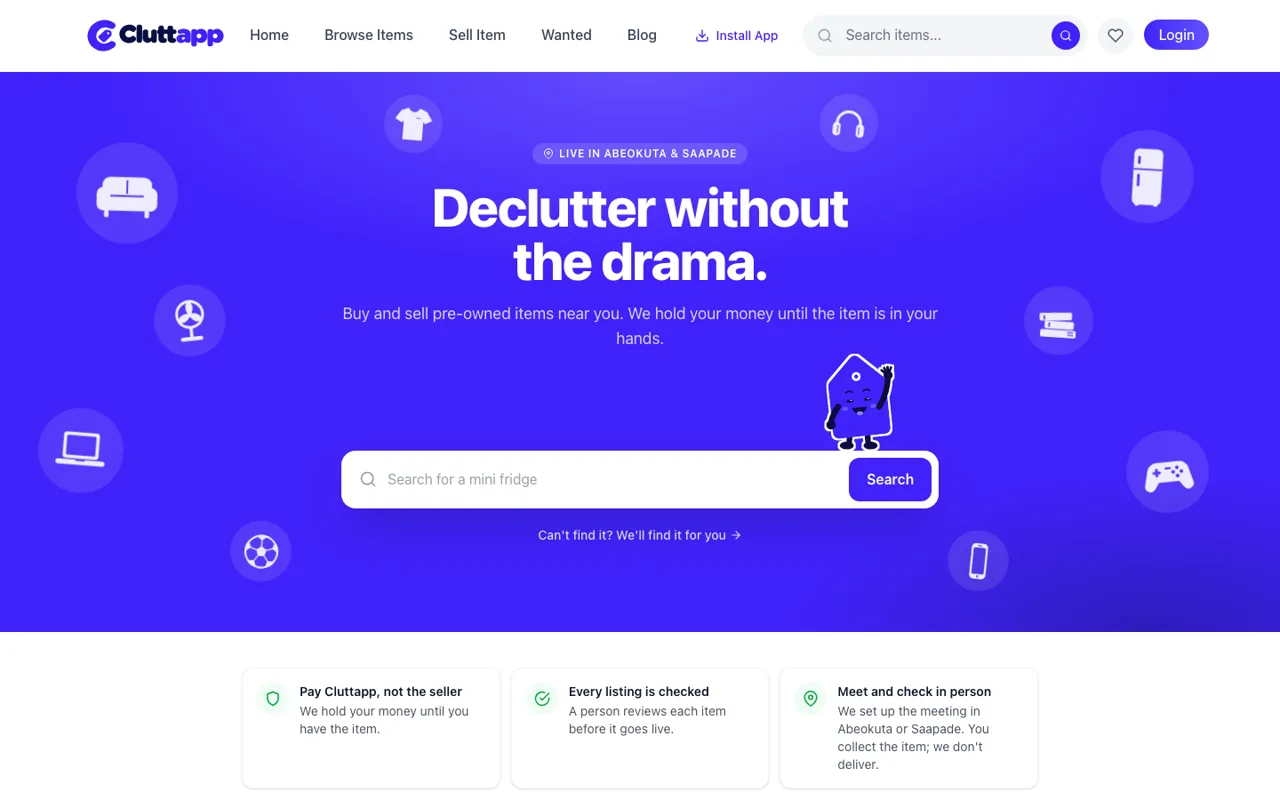
Cluttapp is a second-hand marketplace for Abeokuta and Saapade. I researched how people actually declutter, cut out everything that made them give up, and built the whole business: the brand, the apps, a WhatsApp assistant and the console the team runs it from.

01 · Field notes
It doesn't happen on marketplaces. It happens in WhatsApp declutter groups, and many of them are admin-only: sellers send their items to an admin, the admin posts them, and buyers scroll. Hundreds of posts a week, no filters, and search only finds words in captions, so the fridge you need is buried under yesterday's shoes.
Find something and the work starts: DM the seller, ask "is it still available?", haggle, then decide whether to pay a stranger first. The big all-in-one platforms answer this with more: more listings, more filters, more ads, more strangers.
So people go back to the oldest system there is. They hand the item to someone they trust and let that person sell it.
Air Force 1, size 43, neatly used. ₦18k. DM 0803 ••• ••••
32" LG TV, works perfectly. ₦45k
4 by 6 bed frame + mattress ₦60k
LG, still very cold 🥶 ₦85k, Camp
It was right hereiPhone XR 64GB, clean. ₦160k. Serious buyers only
Reading table and chair ₦22k
Illustration of a typical admin-only declutter group.
The insight
The middleman wasn't the problem.
The middleman was the product.
People didn't want another platform. They wanted someone trustworthy in the middle. Cluttapp is that someone, made fast enough to work at scale.
02 · Design by subtraction
Most of the product is what I chose not to build. Each friction from the field became a rule the whole system follows.
"If I pay first, will I get scammed?"
Pay Cluttapp, not the seller. We hold the money until the item is in the buyer's hands. Trust moves from a stranger to the brand.
"Is it still available? Last price?"
Sellers' contacts are never public. The team checks availability and arranges the handover, so sellers stop getting spammed and buyers stop getting ghosted.
"Half these listings are fake."
A person checks every listing before it goes live. Fewer items, all real.
"Delivered broken, now we're fighting."
No delivery, on purpose. The buyer inspects the item in person and carries it home. One rule removes a whole category of disputes and costs.
"Too many places, not enough buyers."
Two hubs only: Abeokuta and Saapade. Density before reach. A buyer is never more than a short trip from the item.
"I searched. It's not there."
"Can't find it? We'll find it." Buyers leave a request and the team goes and finds it. A dead end becomes a lead.
03 · The product
The same marketplace on the web and on iOS and Android. Scroll through a buyer's and a seller's journey.
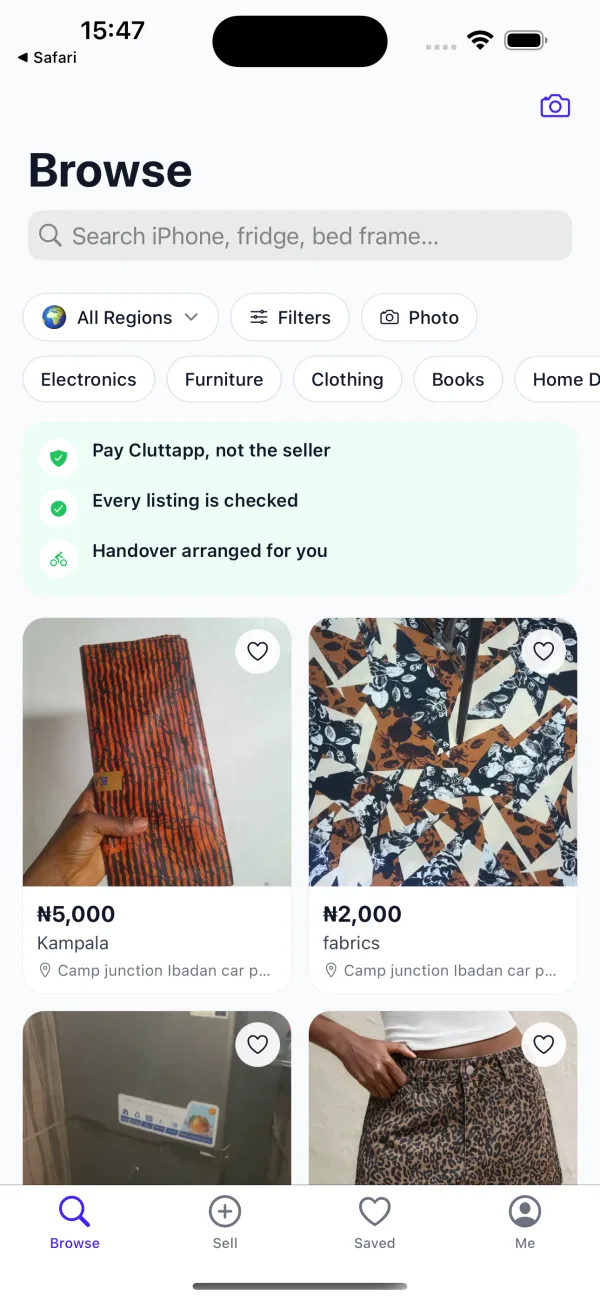
The promise sits right under the search bar: pay Cluttapp, every listing is checked, the handover is arranged. Trust comes before the first scroll.
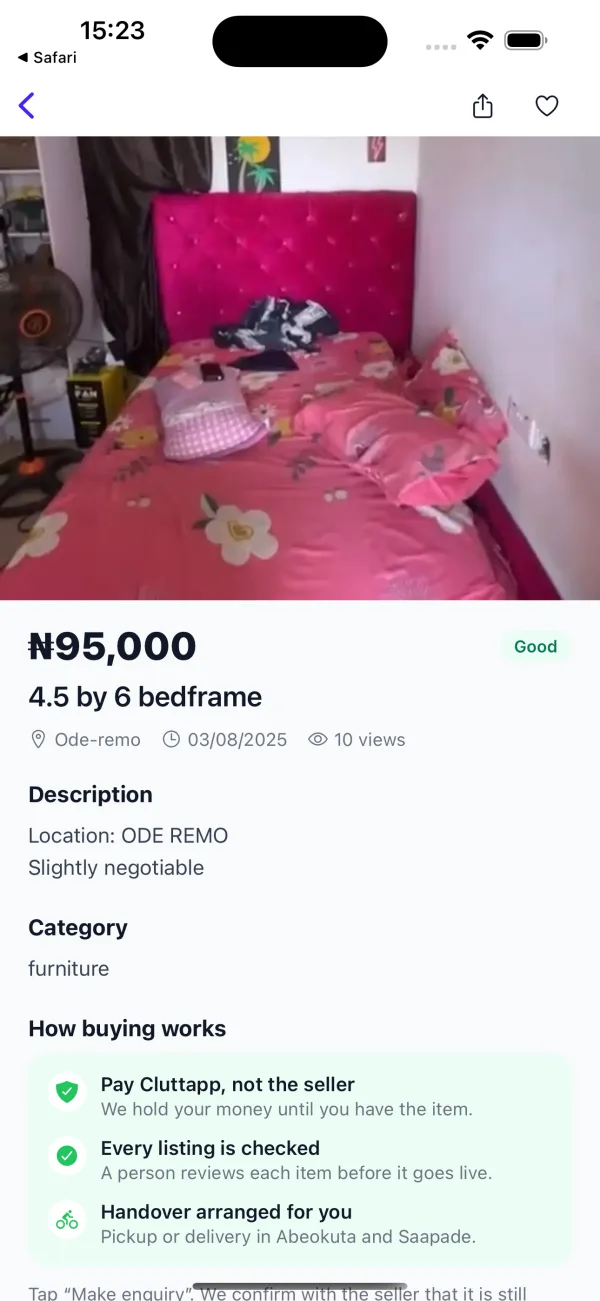
No seller phone number, no haggling thread. Every item page explains how buying works in three lines, and the money goes to Cluttapp until the buyer has the item.
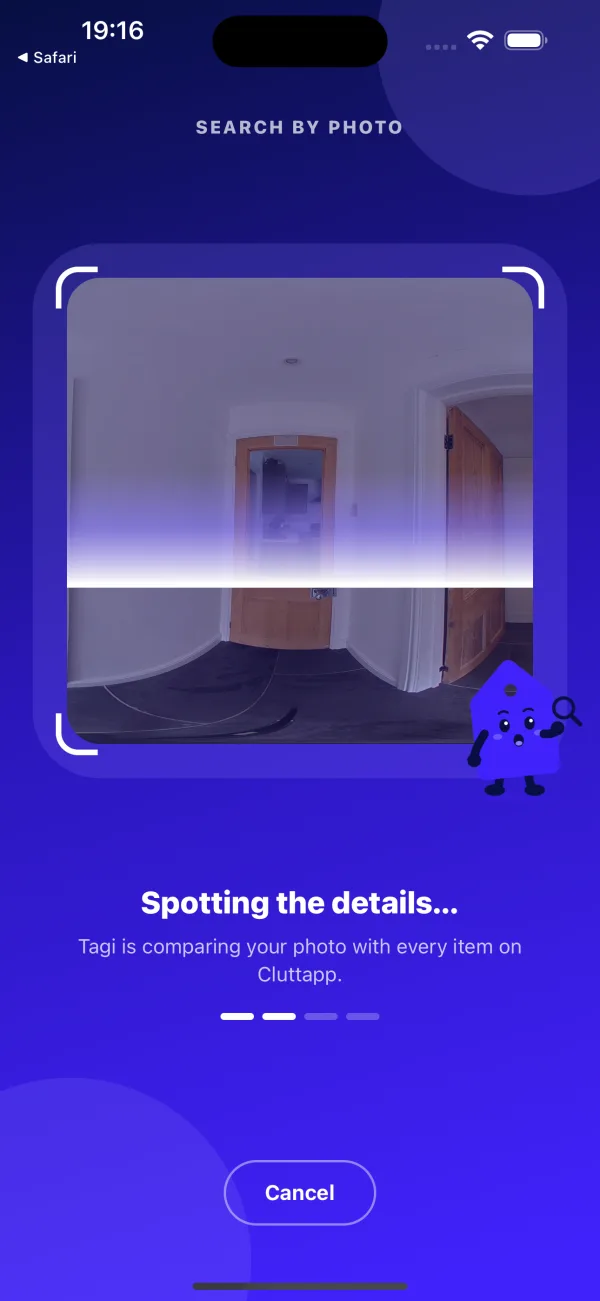
People don't always know what a thing is called. Snap it and see similar items for sale. Search also understands what you mean, so "something to keep drinks cold" finds a fridge.
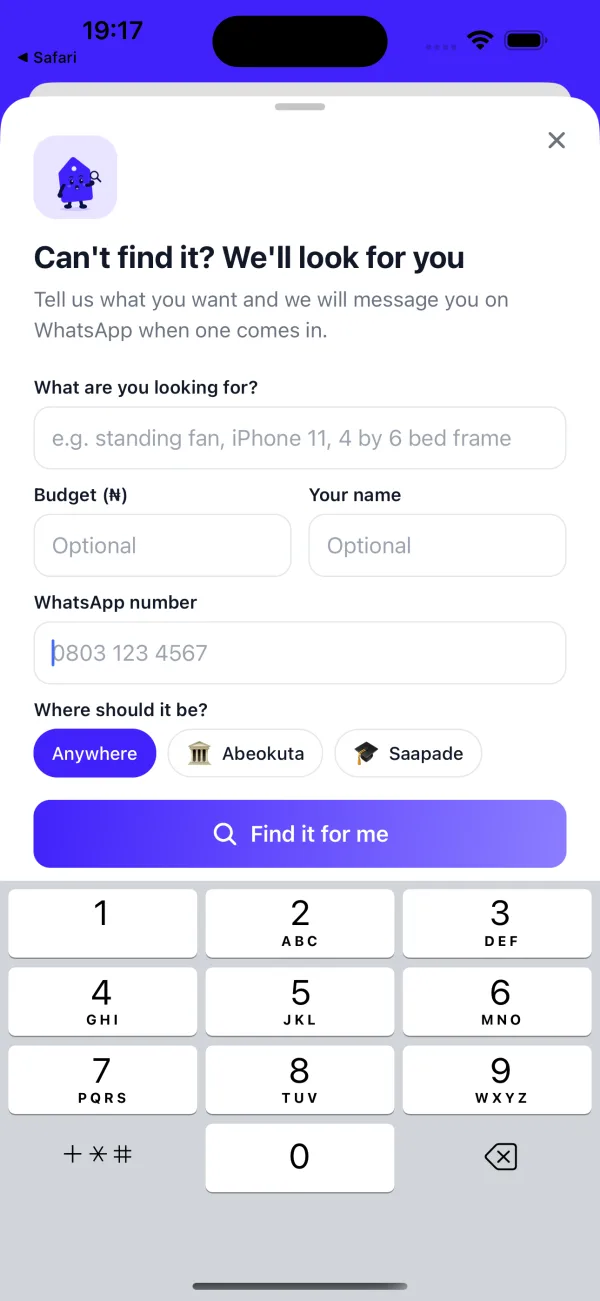
Four fields and a WhatsApp number. When a match is listed, or the team sources one, the buyer gets a message. Every failed search becomes demand data.
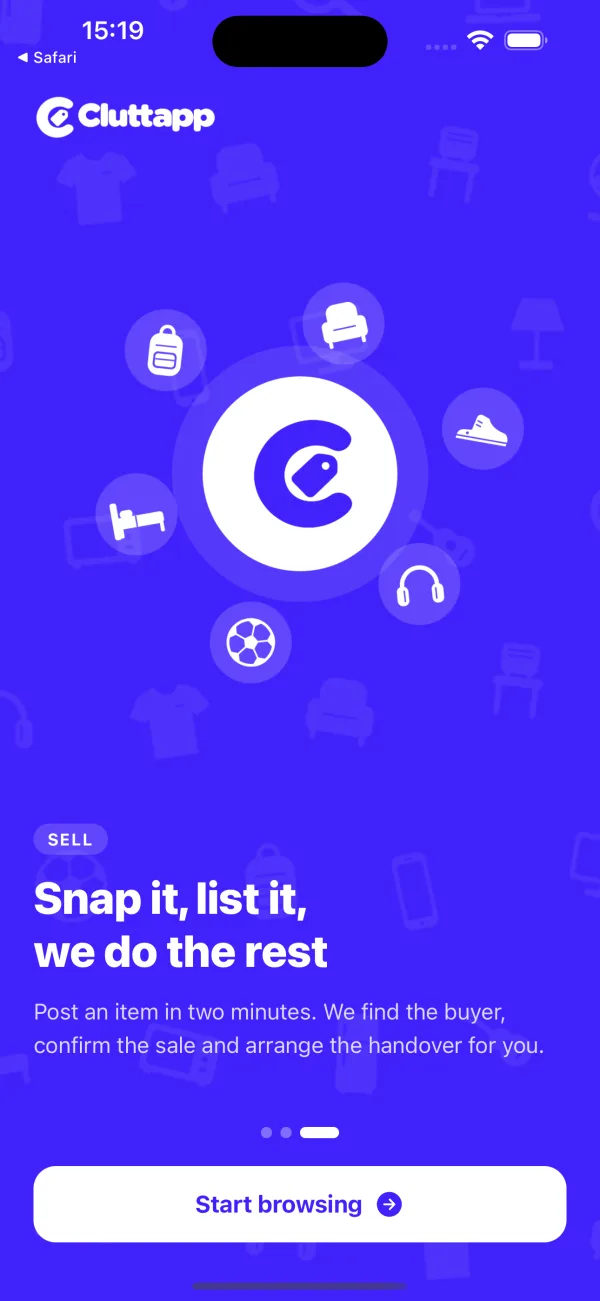
Selling takes about two minutes. AI suggests the tags, the team checks the listing, finds the buyer, confirms payment and arranges the handover. The seller just shows up with the item.
04 · Tagi, the WhatsApp assistant
App store reviews were slow, and every week people asked where to download Cluttapp. But everyone in the market already lives on WhatsApp. So I put the whole marketplace there.
Tagi is an AI assistant on Cluttapp's official WhatsApp number. Buyers browse, search with a photo or a voice note, check availability and pay, all without leaving the chat. Sellers list items through forms inside WhatsApp. Nobody needs an account just to buy.
05 · The operating system
"We handle it" only works if the team can actually handle it. The console turns every promise on the storefront into a job with an owner and a status, from a new listing to a confirmed handover.
Here's what needs you today
New listings
4
Sales in progress
6
Requests to find
7
Handed over this week
12
4.5 by 6 bed frame
₦95,000 · Saapade
Mini fridge
₦120,000 · Saapade
Reading table
₦40,000 · Abeokuta
The business doesn't depend on one person. Staff take on the daily work, each seeing only what their job needs.
When a buyer or seller needs attention, the right person knows straight away, not hours later.
Anyone on the team can see what happened on a sale in seconds, without digging through phones.
A blog editor and search-friendly listing pages bring in buyers from Google without paid ads.
06 · Brand
I designed the brand from the strategy out: the position is "the trusted middle", so the logo is a C holding a price tag. Tagi, the mascot, is that price tag come to life. It waves on the home page, hunts in search, guards payments and celebrates a find, so a serious promise ("we hold your money") still feels friendly.
07 · Built like a company
items listed and checked
ways to buy: web, iOS, Android, WhatsApp
hubs, chosen for density over reach
builder: research to release
A CAC-registered business with an official WhatsApp Business number, published terms, a refund policy and consent-first analytics.
Growth features wait for the rules. Anything that counts as a promotion goes live only once it's properly registered.
Costs stay low as it grows, and revenue comes from a commission on every completed sale. The business makes money only when it delivers.
What's next
Partner with existing declutter groups. They have the audience. Cluttapp brings payment protection and handover to their deals.
Open new hubs one at a time. The same playbook, repeated in towns with students and young workers on the move.
The operating playbook stays private: the handover process, the sourcing network, how Tagi decides what to say, and the numbers behind the model.
I'll study how it really works, and build the system it should have had.
Back to case study 01
360 Property Hub: from scattered DMs to one deal-flow system.
Read it